

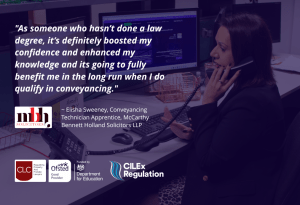
 Is your firm still paying privately for your conveyancers’ qualifications? If so, it’s worth pausing before the next diploma invoice lands. Many conveyancing firms don’t realise they can access government funding to train and qualify their staff instead of paying for the qualifications full price. Through the Level 4 Conveyancing Technician apprenticeship (funded up to £10,000) and the Level 6 Licensed Conveyancer apprenticeship (funded up to £18,000), existing team members can progress all the way to a practicing licence without the firm covering the full cost of private diplomas. This article explains how the funding works, why both programmes are aligned with the Council for Licensed Conveyancers (CLC), and what it means for your practice.
The Funding Most Conveyancing Firms Overlook
Conveyancer training has traditionally been treated as a private cost, the firm, or sometimes the individual, pays for a diploma out of pocket. That model is increasingly hard to justify when it comes to nearly £5,500 for Level 4 & Level 6. Both the Level 4 Conveyancing Technician and the Level 6 Licensed Conveyancer routes are recognised apprenticeship standards, which means the bulk of the training cost is met through government apprenticeship funding rather than your fee income.
The headline figures are significant: up to £10,000 of funding for the Level 4 and up to £18,000 for the Level 6. The exact contribution your firm makes depends on whether you pay the apprenticeship levy. Levy-paying firms draw the cost from their levy pot, while smaller non-levy firms typically co-invest only a small percentage of the funding band, with the government covering the rest. Either way, the cost of getting a member of staff qualified falls dramatically compared with a privately purchased diploma.
What the Funding Covers
- Existing staff can qualify as Licensed Conveyancers without your firm paying for private diplomas.
- The training maps to CLC competence standards, so you are funding a recognised, regulator-aligned qualification, not a generic course.
- The programme is 100% conveyancing-focused, with no irrelevant areas of law padding out the syllabus.
- Both the Level 4 and Level 6 sit with a single provider, so the route runs end-to-end rather than being split across separate courses.
How the Level 4 and Level 6 Apprenticeships Fit Together
The two programmes form a clear progression pathway. The Level 4 Conveyancing Technician apprenticeship builds the technical grounding a fee earner needs to handle conveyancing transactions competently. On completion, learners can be published on the CLC’s Technician Directory, a public marker that they have reached a recognised standard.
From there, the Level 6 Licensed Conveyancer apprenticeship takes that technician through to full qualification. On completing the Level 6 and gaining their licence, they appear on the CLC Public Register as a Licensed Conveyancer, able to take on the responsibilities and recognition that come with the title. For a firm, that means growing your own qualified conveyancers from people who already understand your clients, systems and case load.
Why CLC Alignment Matters
- Both standards are aligned with the Council for Licensed Conveyancers, so training maps directly to CLC competence requirements rather than a provider’s own interpretation.
- The Level 4 leads to the CLC Technician Directory, giving qualified technicians visible, verifiable status.
- The Level 6, plus a licence, leads to the CLC Public Register, the formal record of practising Licensed Conveyancers.
- The route stays specialist throughout, keeping learners focused on the property law work your firm actually does.
What This Means for Your Firm
For partners and practice managers, the case is largely a financial and retention one. Paying privately for diplomas is a sunk cost with no funding offset. Using the apprenticeship route lets you redirect that spend, qualify your people through a regulator-aligned programme, and build a pipeline of conveyancers who are loyal to the firm that invested in them. In a market where qualified conveyancers are in short supply, growing your own is often more reliable than recruiting.
It is worth noting that Datalaw is one of only three training providers offering both the Level 4 Conveyancing Technician and the Level 6 Licensed Conveyancer apprenticeships. That matters because it keeps the full route, from enrolment through to a name on the CLC register, with a single provider, rather than asking your staff to move between courses and providers mid-journey.
Questions Worth Asking Before You Pay Another Invoice
- Are we currently paying privately for any conveyancer’s diploma that could instead be funded?
- Do we have existing staff who could realistically reach Licensed Conveyancer status through the Level 4 then Level 6 route?
- Are we a levy-paying firm with unspent levy funds that will otherwise expire?
- Would keeping the whole route with one provider reduce the admin and risk for our team?
Key Takeaways
- Firms paying privately for conveyancer qualifications can instead claim government funding, up to £10,000 for the Level 4 and up to £18,000 for the Level 6.
- Existing staff can qualify as Licensed Conveyancers without the firm covering the cost of private diplomas.
- Both apprenticeships are aligned with the Council for Licensed Conveyancers, mapping directly to CLC competence standards.
- The Level 4 leads to the CLC Technician Directory; the Level 6 plus a licence leads to the CLC Public Register.
- It is a 100% conveyancing-focused route, and Datalaw is one of only three providers offering both levels end-to-end.
If you have conveyancing staff who could qualify, register your interest in our conveyancing apprenticeships and we’ll send you the funding details for your firm.